Cataract that this world is, it is remarkable to consider what does abide in it.
~ Marilynne Robinson, Gilead
Saturday, December 31, 2011

T e n f o r 2 0 1 2
t e n
~ released in 2011
~ if i received them after dec 1, they're not included here, as i have to live a good while with any music to assess its staying power - this omits, for this list, some really strong releases i have just begun to spend time with; and some just released in dec. that i am anticipating with high hopes, e.g., ew1102 and ew1103/4; and. as i said, i have heard a few post dec. 1 releases sufficiently to say they are glaring omissions e.g., kelley/block, and a real year-end revelation for me, rale/william hutson's some kissed charms that would not protect them, a gem...AND, a few i have heard for many months, but will not see release until 2012 [one will no doubt be on my 2012 list, whatever else may come next year]; this goes to jon abbey's point about the folly of making a list in december].
so in the spirit of folly & ambivalence [in no particular order]:
[1] michael pisaro: asleep, street, pipes, tones/hearing metal 2/hearing metal 3

[2] thomas ankersmit/valerio tricoli: forma II

[3] jason kahn/hong chulki/jin sangtae/choi joonyong/ryu hankil/park seung jun: dotolim

[4] haptic: scilens

[5] jamie drouin/lance austin olsen: savonarola/1498/absence & forgiveness

[6] nathan mclaughlin: echolocation #5

[7] mohammad: spiriti

[8] nicholas szczepanik: please stop loving me

[9] joe panzner: clearing, polluted

[10] keith rowe/radu malfatti: Φ

The come from outta the blue pick is panzner's stunner.
p/s a lot of list-maker's enjoy an also-ran, close-but-no-cigar sort of ancillary list; i'm not going there, but understand the tic - there are some close contenders just outside the boundary of these 10.
p/p/s no need to point to the inclusion of three by the olsen/drouin duo, and by pisaro, i've done the math: it would be a lengthy exchange if i were to clarify how i hear all of pisaro's works of the past several years as one, whatever distinctions between them obtain. the case for the multiple inclusions with drouin/olsen is even more literally true.
Thursday, December 29, 2011
an echo of nothing
Value judgments are destructive to our proper business, which is curiosity and awareness.
~ John Cage
Every something is an echo of nothing.
~ John Cage
Ben Owen, the Brooklyn-based animus behind some of the most striking visual and musical work coming out of the worlds of microsound and letterpress art, comes to mind here. Owen's clearly makes discerning choices in his sound assemblages, but curiosity and awareness seem to guide his explorations as much as anything. On birds + water 1, released on the Notice Recordings imprint, the listener is invited to attune their curiosity and awareness as finely as possible, in order to hear in the illusory stasis and quietude of this cassette release's two sides, the fluent life within.

The context for birds + water 1 was a residency Owen had at the Experimental Television Center in Owego, N.Y., in 2010. The ETC enjoyed a 40 year history of supporting media artists, long before, let's note, mixed media works were de riguer. From early experiments by Cage biographer Richard Kostelanetz, to Nam June Paik, to Keith Rowe collaborator Kjell Bjorgeengen, to Ben Owen, the ETC provided a stream and a lineage for works like birds + water 1. Owen's residency came just before ETC ended its multi-generational run, and with that in mind, this work serves as a lovely coda. [Note that birds + water 2 & 3 are available on the Russian sound art imprint obs].
We are, of course, a bit hobbled by hearing the audio separated from the visual; both sides are unedited, I believe, in duration and content. Each offer the pleasures, as I suggested, of attuning our ears to what seems at first blush to be generally steady-state frequency waves, but as our attunement continues, reveal a teeming world of detail and echoes of something. This is brought home dramatically when the B side piece ends just like that, and your listening environment rushes into the sudden vacuum.
Having heard a number of works by Owen, and having spent hours looking at the letterpress work he creates through Middle Press, I sense he is a kindred spirit of Akio Suzuki, another musician who communicates a deep respect for his materials, his environment, and his listeners. Owen's visual works are alert to issues of sustainability, for example, using soy ink in his letterpress designs, and he appears ever-mindful of the super-saturated world of sound and vision we are all caught up in. This awareness manifests in these sound works, seeming to aspire to the zen edict leave no trace.
Notice Recordings
ben owen
photo: The Experimental Television Center, Owego, N.Y.
When you do something, you should burn yourself up completely, like a good bonfire, leaving no trace of yourself.
~ Shunryu Suzuki
~ John Cage
Every something is an echo of nothing.
~ John Cage
Ben Owen, the Brooklyn-based animus behind some of the most striking visual and musical work coming out of the worlds of microsound and letterpress art, comes to mind here. Owen's clearly makes discerning choices in his sound assemblages, but curiosity and awareness seem to guide his explorations as much as anything. On birds + water 1, released on the Notice Recordings imprint, the listener is invited to attune their curiosity and awareness as finely as possible, in order to hear in the illusory stasis and quietude of this cassette release's two sides, the fluent life within.

The context for birds + water 1 was a residency Owen had at the Experimental Television Center in Owego, N.Y., in 2010. The ETC enjoyed a 40 year history of supporting media artists, long before, let's note, mixed media works were de riguer. From early experiments by Cage biographer Richard Kostelanetz, to Nam June Paik, to Keith Rowe collaborator Kjell Bjorgeengen, to Ben Owen, the ETC provided a stream and a lineage for works like birds + water 1. Owen's residency came just before ETC ended its multi-generational run, and with that in mind, this work serves as a lovely coda. [Note that birds + water 2 & 3 are available on the Russian sound art imprint obs].
We are, of course, a bit hobbled by hearing the audio separated from the visual; both sides are unedited, I believe, in duration and content. Each offer the pleasures, as I suggested, of attuning our ears to what seems at first blush to be generally steady-state frequency waves, but as our attunement continues, reveal a teeming world of detail and echoes of something. This is brought home dramatically when the B side piece ends just like that, and your listening environment rushes into the sudden vacuum.
Having heard a number of works by Owen, and having spent hours looking at the letterpress work he creates through Middle Press, I sense he is a kindred spirit of Akio Suzuki, another musician who communicates a deep respect for his materials, his environment, and his listeners. Owen's visual works are alert to issues of sustainability, for example, using soy ink in his letterpress designs, and he appears ever-mindful of the super-saturated world of sound and vision we are all caught up in. This awareness manifests in these sound works, seeming to aspire to the zen edict leave no trace.
Notice Recordings
ben owen
photo: The Experimental Television Center, Owego, N.Y.
When you do something, you should burn yourself up completely, like a good bonfire, leaving no trace of yourself.
~ Shunryu Suzuki
el otro piano
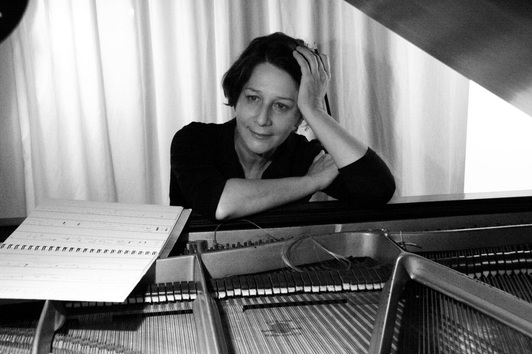

I am, presumably, similar to many of you who read these sorts of reviews; we occasionally suffer from a surfeit of challenging music, with the peculiar symptoms of information-sickness and innovation-enervation, the predictable consequence of avidity in extremis, of too-much-of-a-good-thing-is-a-bad-thing. The anodyne that acts most immediately, for me, is silence; the middle ground is discovering music that has a little surprise in its folds, what I consider fresh tangents, as very little comes along in a lifetime bearing that most potent medicine, radical innovation.
Sometimes my delight is in the perfect storm of musical surprises, when the where [geography], the what [in this instance, two instruments so overly-familiar as to raise in us a demand for a fresh yield of surprises], and the when and how [delivered to us from a label so small, it has folded from a largely cd-r catalog, chronicling the work of many musicians completely unknown even to improvisation's miniscule market share, to a digital download net label, and struggles mightily to survive at all - and is based in Florida!].
I am referring to Travis Johnson's Ilse imprint, for which I wrote the liner notes for one of the label's last releases. Johnson's efforts to maintain Ilse are hardly the stuff of sob story nor self-pity; what I know of his efforts does convey a familiar story of obsessive fidelity to a music that risks failure so intentionally, madness [and the concomitant financial stress] eventually ensues.
Let me break that down - the where is Argentina, the what is a piano approached and sounded from every conceivable angle, and an analog mixer with the inputs connecting to the outputs - you've heard this before, right? - and the when and how, as I said, is music borne from a parlor recording made in a musician's house in Buenos Aires, by a Floridian who just loves this kind of shit. The result is piano + no-input mixer, the duo of Ana Foutel and Federico Barabino.
As I have said Ilse documents music that risks failure intentionally, let me quote Barabino briefly - ...the error as a starting point for an exploration often denied...and a continuous search inside and outside margins are the very concept of this way of working. Much about this surprising release bears the ethos of courting error - the infiltration of the duo's playing, not by edited/integrated field recordings, but by the traffic outside their session; the plangent creaks and groans of Foutel's floors as she moves around the piano; the unwieldy, unstable sine tones loosed here and there, shooting through the sonorous piano clouds with an impertinent disregard for complementarity; and, still for many, the vast stretches of near silence, in which it occurs to one perhaps Barabino [and occasionally Foutel] have left the room.

In fact many listens will clarify that this duo are playing with keen, alert listening skills, a restraint that is signal of their respect for making the right sound, and that, to my ears, Barabino is always lightly limning and framing Foutel's pianistics, which are considerable. Barabino's mixer is emptier than many of his contemporaries here, and I suspect that is entirely intentional, given the results. Connecting inputs to outputs can raise holy hell, especially when the approach, as Barabino states above, is to move in and out of the margins of sound. That his playing serves the duo so well places him on my radar for future projects.

Foutel is an accomplished pianist who also moves in and out of the margins, as well as the pedals, keys and soundboard of her instrument. If I place too fine a point on her amazing technique, or the endless, liquid transitions from caress to pluck to rubbing to melodic inventions, I am afraid you will think meh, a catalog of techniques. Yes, in the service of two episodic unspoolings of potent improvisation, a considerable revelation of technique. But not a catalog - Foutel has integrated her approaches too deeply, and plays with too much regard for space, nuance and suggestion, to be guilty of exhibitionism.
She is the author of a 63 page primer of prepared piano, entitled El Otro Piano, demystifying the nuts and bolts method that yields such orchestral sounds. But again, all of this serves up piano music that swings, sways and, as often, ellides from one mood to another, at times desolate and bare-bones, at others a sort of hammered romanticism that animates Foutel's fierce, tough, beautiful playing.
As a duo, Barabino and Foutel manage to evince a quite rare quality in encounters between improvising musicians wielding such disparate sound-sources - an unmistakable respect for the encounter itself, for the ground shared, and for the vast ground between them. explored in an affecting, but slightly at-a-distance, parallel play.

Sunday, December 18, 2011
gather 3 / pure and stripped
You will obtain a vision of matter that is perhaps fatiguing for your imagination, but pure and stripped of what the requirements of life make you add to it in external perception.
~ Henri Bergson
The gathered releases considered here are as disparate and divergent as any I might bundle for review. These gatherings are selected by no other design or consideration than their place in my review queue This batch, however, possesses a quality of intense focus and minimal means that brought to mind the descriptor stripped down. Listen to them in rotation, as I have done these past weeks, and it becomes very clear that the scope of stripped down is actually as vast as the ocean.
Several are organized around, as has happened increasingly in my sphere of listening projects, location/field recordings. Many of the releases I wrote about most enthusiastically last year integrated similar recordings within composed and improvised works for conventional instrumentation; they were, however, characterized largely by a fecundity and abundance of sounds, their weft and weight the result of many sonic layers and striations, both organic and otherwise [Pisaro's July Mountain, Rossetto's Mineral Orange]. The offerings here, excepting a couple pieces on the Chabala/French duo release, Trammels, can be placed on the continuum between stripped down and bare bones. As I said, vast is the acousmatic ocean.
As I was considering stripped down, how close so many musicians I dig are getting to the very marrow where sound and silence manifest most dynamically, I stumbled upon Sciarrino's pith phrase about such things - acousmatic silence is, he said, a silence which itself is an infinite rumbling of microscopic sonorities.

That definition certainly comes to mind listening to much of the recent output of fellows like Jez Riley French, Barry Chabala, Daniel Jones, et al. On Trammels, French and Chabala offer four pieces, three photographic scores by French, and a long-distance sound file collaboration. The first two scores are interpreted by Chabala alone; these are works of medium duration and considerable dynamic range. Chabala's assurance and deft handling of appositely placed sounds and silences continues to impress. He works with seamless segues between silent and near-silent sustained tensions, and surges of floating guitar tones that are simply gorgeous.
These are photographic scores that blend, blur, and cross-fade naive guitar melodies, the shimmer and aura of chromatic droneage, the throbs and oscillations captured on recordings of traffic, both aerial and earth-bound, and, on the third piece, where French takes a solo turn, a mesh of elemental colors issuing from French's arsenal of salt, glass, paper and coiled wire. This last, entitled (...) a coda, ranks easily alongside the aforementioned Daniel Jones' exacting When On and Off Collide [Cathnor 007], as the quietest music I've listened to in a long while. [While I am referencing Jones' work, I'll mention it overlaps with Chabala's approach to sustained silences and surges, and you'd do well to check it out].
Weft and mesh are apposite words for this excellent release, as a trammel [one example pictured above] is a net woven of both very fine and very coarse materials.

Graham Lambkin continues his mission of presenting Belgian composer Moniek Darge's prescient, effulgent work from the past three decades to a new audience, one largely saturated with, among other offerings, today's surfeit of available processed field recordings. To my ears, Lambkin, as I wrote last year, finds in polymath Darge's work a deep resonance with his own, and we are the richer for his restoration act.
Sounds From Sacred Places [Kye Records], first issued in 1987, is comprised of five pieces, all involving Darge's strange, lovely sonic embroidery around site-specific machinery and mechanisms, like those used to toll abbey bells, or the archetypically familiar thrum and drone of power plants [the one pictured above is found in the Turkish Square in Darge's native Gent, yielding my favorite sounds of this release]. There is a remarkable acuity to Darge's listening, manifested in her subtle use of processing, looping and, on Turkish Square, enlacing the natural overtones and resonances at the source of the recording with oscillating tones in such a way that the boundary between Darge and the sacred place is erased. Easier said than accomplished, as evidenced by so many current works using location recordings. The last two pieces are overtone-rich bell-tolled waves of pure energy, far ahead of similar works to come in the ensuing nearly three decades.
Every Darge release Lambkin has reintroduced on his Kye imprint [this is the third] merits your attention, if you are at all keen on music made by composers who know where to place their attention in any noisy environment, alert to the possibilities, and sift and strain from the blooming, buzzing confusion, particles of the sacred.

Speaking of archetypes, Taku Unami.
Initially some cast him as an enfant terrible [no], and lately he's been discussed as either the anodyne for an enervated area of music, or the naked emperor. In my review of Unami's delightfully vexing duo with Annette Krebs, motubachii, I quoted Erstwhile Records' Jon Abbey description of their work as a puzzle box of sound. Earlier this year, in his raucous stand [face it, relative to most EAI performances, Unami is raucous] at the Amplify 2011 festival, Unami dashed the puzzle, and made his sounds from boxes. To my ears [handicapped by not yet experiencing Unami in performance], he is the archetypal trickster, manifested in Japanese popular consciousness [and occasionally popping up in Miyazaki's fantastic films] as the kitsune. They are any scenes' heterodox, garnering both, as witnessed on music fora, opprobrium and hero-status. These are equally silly takes; Unami, I am confident, loves mischief - but mischief made skillfully and, at times, elegantly.
His two duos on the elegant winds measure imprint will do nothing to mollify the detractors, and may well solidify his kitsune status. I am, despite many listens to both, especially reluctant to say much about these releases. am wind, d±50 pairs Unami with Wandelweiser composer Stefan Thut; one side is comprised of wind recordings and measured silences, the other of Thut's cello, Unami's subtle sine tones, and a hella amount of environmental noises leeching and limning the duo's sound. I will break my reluctance [some stuff for me just necessitates as little verbiage as possible, if you think, as I do, that our responses as listeners are accretions that become attached to the music itself] to say this is a lovely release that sits, on our continuum of the pure and stripped, at the most austere point [alongside French's (...) a coda] of the works gathered here.
Unami's duo with Angharad Davies, two hands, seems to have pushed a few of my fellows into the naked emperor contingent. Both sides consist of much sporadic clapping; on one side, Unami claps, Davies, a remarkable violinist, scrapes, rubs and plinks in parallel play; on the other side, both clap. If this doesn't piss you off, or strain credulity adequately, most of the hand claps are at ppp or pppp. Unami's embrace of the stripped down - on antecedent works, such as motubachii, he claps amidst many other generated sounds - comes across as vulnerable, and anti-virtuosic. The degree to which you regard this sort of offering as precious or calculatedly naive will determine how you feel about my favorite kitsune's current work. I am confident that you will agree winds measure is producing the most beautifully designed packaging available.

I was pretty effusive about Ernst Karel's last location recording, Heard Laboratories, taking the opportunity to reprise Truman Capote's pith observation I believe more in the scissors than I do in the pencil. This is Karel's great knack, his intuitive selection of sounds, sound-shaping, and - I hasten to add as one who feels the onus of every new release that insists on 70-80 minutes of sound because the media allows it - concision, privileging the scissors as much as the pencil [the total time is 78 minutes, but spanning nine tracks offering an amazing variety of sounds and rhythms].
Works like Swiss Mountain Transport Systems, its prosaic title redirecting your attention back to the music, where it belongs, evince in me a feeling I value a great deal - as much as the important question is do I like the sounds, the work reminds me I have a kindred spirit in these realms, the realms of music I hear daily in nearly every environment I pass through. Karel hears machinery singing, in this instance the gondolas and chair lifts that transport humans into a vastness of space that makes attunement to their music an antidote to the feeling of total engulfment that must visit anyone riding and rising to such altitudes.
Machines like the one above do sing, and we only occasionally hear a human voice penetrate their secret concentus. Upper partial winds, droning continuous cable systems, and singing tramways - Karel reveals, as he did with the research labs at Harvard, as Darge has for many years, that it is people, places and things that make music, whether we pass by or not. Karel passes into these sound worlds, pointing his microphones, and our attention, just where they are needed. Of course, this is the documentarian's gift to us, a glimpse of otherwise inaccessible worlds, pure and stripped of everything but what we need to hear the music.
- ...the blooming, buzzing confusion... is from William James' studies in categorical perception.
- The kitsune, the Japanese archetype for the trickster, is depicted as a fox. While the Amerindian trickster, the coyote, works as well, when I think Unami, I think fox.
Subscribe to:
Posts (Atom)